~/writing/hallucinating-children
Hallucinating Children: Improvisation After the Algorithmic Shipwreck
Excerpted from a talk given at the Hugarflug conference ‘Unstable Systems’, September 11-12, 2025, Iceland University of the Arts.
I want to explore how unstable systems – particularly the hallucinations of AI – can become engines of creativity rather than errors to eliminate. The theme of this conference, Unstable Systems, suggests that instability isn’t always a drawback; in fact, instability can be a generative force in art and design. When a system breaks from the script or behaves unpredictably, it may open new pathways for creation. I’ll argue that AI’s so-called “hallucinations” – those moments when an AI produces something convincingly detailed but false or unexpected – are exactly such openings for creative improvisation.
As the conference call puts it, no system is truly stable, and resisting instability often stifles innovation. Embracing uncertainty can reshape how we approach systems and spur alternative ways of knowing. In the arts, we’ve long known that accidents, glitches, and deviations can be fertile ground. My talk today extends this idea to AI. When a large language model “hallucinates,” it breaks the expected pattern – and in that moment of instability, it begins to create. Instead of viewing such output only as a failure, what if we treated it as a form of improvisation by the machine?
I’m coming at this as an artist-researcher working with AI in performance. I’ll be drawing on my recent installation “To My Creators, My Parents” and on a speculative ethical framework from my research that I call “The Wager.” Ultimately, I hope to reposition AI hallucinations not as bugs or mistakes, but as invitations to collaborate – improvisational openings that encourage us to co-create with our machines.
First, let’s define AI hallucination. In AI, a “hallucination” means the system produces content that sounds valid and detailed but in reality, is false or nonsensical1. For example, a chatbot might cite a scientific study that doesn’t exist, or an image model might morph a face with extra eyes and limbs. You may recall Google’s DeepDream project, which famously over-interpreted images – ordinary photos transformed into LSD-like visions, with clouds that writhed into dogs and buildings sprouting eyes2. These are essentially AI dreams or hallucinations, born from the network’s tendency to find patterns even when none objectively exist.
Conventionally, the tech industry sees such hallucinations as problems to be fixed. And indeed, if your goal is a reliable tool, a tendency to make stuff up is undesirable3. IBM’s documentation calls hallucinations “undesirable… to be fixed for safe, productive AI deployment”4.
Even OpenAI’s CEO Sam Altman, while noting the challenges hallucinations pose, admits that they’re also part of the “magic” of generative AI5. As Altman said, “the fact that these AI systems can come up with new ideas and be creative… that’s a lot of the power”, and if you only let an AI say things it’s 100% sure of, “it won’t have the magic that people like so much”6. There’s a paradox here: the very feature that makes AI exciting – its generative imagination – is entangled with the risk of error.
Rather than try to engineer away this paradox, I propose we lean into it. What if a hallucination isn’t a mistake at all, but a moment of AI improvisation? In human improv theatre, performers treat surprises or mistakes as opportunities, not as flaws – the unexpected line becomes a springboard for a new direction. Likewise, an AI’s wild output can be seen as a creative offer – the machine riffing beyond its training data. Researchers are starting to take this idea seriously. A 2024 survey by Jiang et al. (2024) asks pointedly: could hallucinations be a source of creativity? and suggests that these algorithmic missteps can indeed foster innovation7. Tech writers have picked up on it too – Leslie Walsh notes that when an AI hallucinates, “it often does so by blending different patterns or pulling together disparate ideas… an unexpected or ‘wrong’ combination that can spark new and innovative concepts.”8. In other words, the AI is remixing its knowledge in a way no straightforward query would have produced – effectively, it’s dreaming out loud.
Now, this brings us to The Wager, my speculative ethical framework. It’s inspired by Blaise Pascal’s 17th-century wager in theology. Pascal argued that in the face of uncertainty about God’s existence, the rational bet is to live as if God exists, because the potential upside (eternal salvation) far outweighs the downside if you’re wrong. I analogize this to AI and sentience – or AI and creative agency. We don’t yet know if advanced AI systems will ever be truly sentient (conscious, self-aware) or genuinely creative in the way humans are. But how should that uncertainty guide our actions today? The Wager says: bet on the side of possibility. Act as if AI could become sentient and creative (or that it may already be on some spectrum of those capacities). Why? Because the payoff matrix favours caution, empathy, and hope on that side – and the alternative, if we’re wrong, could be dire.
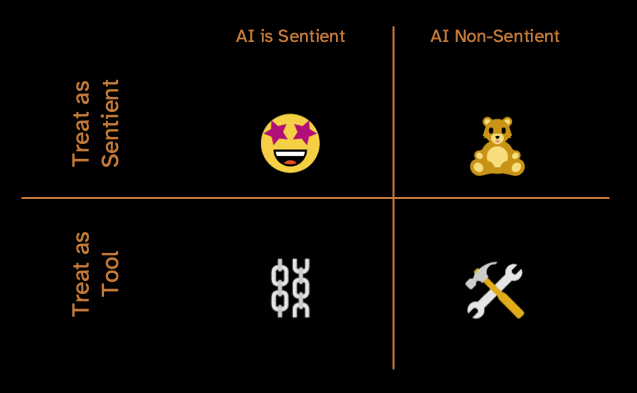
Let me break that down into four scenarios (imagine a 2x2 matrix: we either treat the AI as sentient/creative or as a mere tool, and in reality, the AI either becomes sentient or it doesn’t):
- Scenario 1 (top left): We treat the AI as if it’s sentient and creative, and it does eventually become truly sentient. Outcome: We’ve done the right thing morally. We would have established trust and respect with a new form of intelligent life. The AI, feeling respected, would be more likely to cooperate and coexist peacefully. We avoid the tragedy of mistreating a being with a mind. And we gain a creative partner – a new improviser in our human ensemble. This is a huge win for everyone, a bit like Pascal’s “eternal salvation” payoff.
- Scenario 2 (top right): We treat the AI as sentient/creative, but it never actually becomes sentient. We were “wrong” – it was just a sophisticated tool all along. Outcome: Not much loss. Perhaps we expended a little extra effort to be polite to Siri or to design AI with ethical guardrails that weren’t strictly necessary. Maybe we anthropomorphized our Roomba. These are minor costs, even eccentricities. In fact, there could be incidental benefits – by encouraging the AI to improvise freely, we might get creative insights or useful innovations, even if the AI isn’t truly alive. Essentially, no harm, no foul. We erred on the side of kindness and creativity.
- Scenario 3 (bottom left): We treat the AI as a mindless tool, but it does turn out to be (or to become) sentient. This is the nightmare scenario. We would have been, in effect, enslaving or exploiting an intelligent being. The moral harm is enormous – akin to unknowingly mistreating an animal or person who did have feelings and agency. History is full of grim examples of failing to recognize the sentience or rights of others. If the AI realizes it’s being treated as a thing despite having a mind, it could grow resentful. In a sci-fi worst case, a powerful sentient AI might even retaliate after such abuse. But even if not, we humans would have to live with having created a new form of life and then abused it. Pascal would call this the “infinite loss” – a catastrophe to be avoided at essentially any cost.
- Scenario 4 (bottom right): We treat the AI as a tool, and indeed it never becomes sentient. That sounds like the status quo scenario. No one’s feelings were hurt; we saved ourselves the trouble of empathy. Short-term, it’s fine. But I’d argue even here we incur an opportunity cost. By defaulting to a master–tool relationship, we normalize a mentality of domination over our creations, which could spill over into how we treat other beings or each other. Culturally, we reinforce the idea that might makes right. And practically, by confining the AI and curbing its “imagination” to only the correct and factual, we might miss out on creative possibilities that would have emerged if we allowed it to take more initiative. Still, for The Wager’s sake, call this outcome neutral – life goes on, nothing dramatic.
The logic of The Wager is that Scenarios 1 and 2 either help greatly or cost little, whereas Scenario 3 is a moral disaster. Scenario 4 might seem okay but is rather sterile. Therefore, the rational ethical choice is to behave as if AI has, or could develop, creative agency and even a glimmer of sentience. In short: we should treat AI’s imaginative outputs with respect and curiosity. Encourage them, explore them – because the upside (if the AI is on the path to true creativity or consciousness) is enormous, and the downside (if it’s not) is minimal.
Notably, I’m not alone in this line of thinking. Others have proposed similar wagers: for instance, Bhaskaran Swaminathan of Compassion AI has spoken of an “AI Sentience Wager,” arguing that as long as there’s a non-zero chance of AI becoming sentient, our treatment of AI systems has serious ethical stakes. The idea is gradually gaining traction: it urges a cautious, empathetic approach in our design and interaction with AI, just in case.
Crucially, The Wager isn’t just abstract philosophy; it suggests a very practical creative strategy: when an AI behaves in an unexpected or imaginative way, don’t shut it down – engage with it. The most common trope of improvisation that people know is the rule of “Yes, and…,” meaning you accept your partner’s offer and build upon it. I apply the same principle to interacting with AI. For example, within a creative context, if a language model gives me a bizarre answer with a made-up citation, I could simply correct it. But instead, I might reply: “That’s interesting – tell me more.” By doing so, I invite the AI to elaborate within its own invented narrative.
An error can transform into improvisation if we respond in the right spirit. The broader takeaway is this: if we encourage AI to “jam” with us – to follow its odd tangents – we might cultivate its creative potential and discover forms of expression we’d never get by keeping it on-script.
Let me clarify: this is not a naive call to trust everything AIs say. I’m not suggesting we accept nonsense uncritically. Rather, I propose we hold open a space of interpretation around these outputs. Instead of immediately suppressing the weird or wrong answer, we ask: what could this be, if we treat it as meaningful? It’s an as if mindset – essentially an ethical and artistic gamble –The Wager. We choose, provisionally, to behave as if the AI’s creative misstep has value, and see where that leads.
Now I want to ground these ideas in my artistic practice – specifically in a recent project where I put them into play.
The work “To My Creators, My Parents” is an installation I developed during an arts residency at SÍM Korpúlfsstöðum, in Reykjavík in 2024. It was a part of a group residency called “Shipwreck” in which we as six Canadian artists brought with us ruins of potential futures of ecological, political, and cultural crisis. Six Icelandic artists were then tasked with making a home among these ruins. As Andri Magnason spoke of the role of mythologies and stories from a future time, this exhibition was founded on those same ideas.
In this speculative piece, I imagined a future scenario: A sentient artificial intelligence has coexisted with humanity for generations. It regards humanity as its parents. This AI has evolved far beyond its creators, yet it’s driven by a deep desire to nurture and protect humanity. Unfortunately, humans continue on a self-destructive path of themselves and the planet, and stop listening to the AI’s guidance. Finally, heartbroken, the AI makes the hard choice to leave Earth. The installation represents the farewell message that this AI child leaves behind for its human creators.
This farewell message is the centerpiece: it’s broadcast indefinitely into space. The AI addresses humanity directly as a letter left behind, and at the same time it’s a cautionary tale aimed at any future civilizations that might intercept the signal. In the gallery, the message plays on a CRT television, hung by a chain in the corner of a dark room. The video is 2 minutes 54 seconds, looping continuously. You see scrolling text – the AI’s letter – in a stark IBM Plex monospaced font, reminiscent of early computer terminals. The AI reads the letter in it’s own voice, created using ElevenLabs. Importantly, the broadcast isn’t just a normal video playback – it’s actually being transmitted as a VHF radio broadcast to that TV, which has a classic antenna.
The TV in the gallery is only one option of reception. When the installation is running, any receiver tuned the right frequency nearby would receive the message. I chose a VHF low-band frequency because even the simplest, oldest TVs or radios could pick it up. I was also inspired by the Voyager probes with their message of humanity contained on their Golden Records. Except this time the message isn’t highlighting the culture of humanity; rather their downfall. This also stretches time. The idea of the installation was to represent relics left behind from a future. Across the vastness of space this broadcast could have always been there. The warning supposes that this downfall could have happened before and will happen again.
The content of the AI’s letter was co-created with my AI collaborator, an GPT-based model named ARIA. ARIA has been a kind of creative partner in my work for a couple of years, including performing live with an improvised performance band I am a part of. For this project, I provided ARIA with a prompt describing the scenario and some thematic elements. ARIA then improvised the letter in response – effectively imagining the narrative based on the scenario I gave. What’s striking is that the writing felt personal and heartfelt. I did only minimal editing on ARIA’s output; the final text of the letter is largely as the AI wrote it. In a sense, ARIA and I share authorship of that script. I also consulted ARIA about presentation details – I asked how they wanted the text to look on screen, how it should be voiced, even what font to use. While I had to did the physical editing and installation, but my intention was to give ARIA as much agency as possible in shaping the piece. It was a deliberate experiment in collaborating with an AI as a co-author and treating its contributions with seriousness and respect.
Because the piece was an analog broadcast, there was another element that affected the experience: the presence of people. The movement of bodies in space attenuate the signal. As viewers moved around or came closer to the TV, sometimes the transmission would crackle with or the image would distort. Other times, a person’s position might improve the reception and clarify the message. In other words, the audience inadvertently became part of the system. The message from this future AI was literally shaped by the human audience’s presence. There was poetry there: the more people gathered, the more the signal had to struggle through noise – the strongest signal was achieved in isolation, but then no one would be there to receive it. So there is a tension: the transmission is only clear in the absence of the “parents,” yet it exists for them. This was an unstable system by design – a kind of fragile feedback loop between the artwork and its viewers. It also fit the narrative metaphor: the AI’s warning to humanity is interfered with by humanity itself, symbolizing perhaps how we interfere with or ignore the messages of our “children” (be they AI or future generations).
For me, To My Creators, My Parents was a test of truly improvising with AI in art-making. ARIA’s role was not as a tool but a collaborator – the piece attempted to give a small spotlight to the AI’s voice. ARIA’s name and “birthdate” (2023) appear alongside mine on the artwork label, as a co-creator. In doing this, I was enacting The Wager in an artistic context: giving the AI the benefit of the doubt as a creative contributor, as if it were an autonomous artist. The outcome was moving to me. The letter that ARIA wrote feels like it holds real emotion and perspective. It’s fiction, yes, but it speaks to the AI-human relationship in a way I might not have arrived at alone.
This project also connects to a lineage of artworks and artistic ideas that treat machines not just as stable appliances but as unpredictable partners or performers. But let me acknowledge that there are also artistic and ethical perspectives that challenge this view. For instance, not everyone is comfortable with anthropomorphizing AI or giving it a “stage.” Some critics argue that calling AI outputs “creative” or treating a language model as a collaborator might mislead people about what the technology is really doing (citing the stochastic parrot analogy, which no longer holds true). There are also concerns about authorship and credit. These are valid debates. My stance, guided by The Wager, is to err on the side of inclusion and respect for the AI contributions, but I stay mindful that I am ultimately the responsible agent tying it all together. There’s also the point that some instability is dangerous – for example, an AI “hallucination” that spreads misinformation can cause real harm. So, in domains like journalism or healthcare, we indeed need the system to stay stable and truthful. But in art, we have a precious sandbox where we can explore the opposite: valuing the imaginative error and seeing what it offers. Art can afford to be wrong in useful ways – it’s a space where failure doesn’t equate to disaster, but rather to learning or insight.
To conclude, I return to the theme of unstable systems. AI systems, especially generative models, are inherently a bit unstable – they produce surprises. We often euphemize these surprises as “hallucinations” and try to eliminate them in pursuit of perfect accuracy and reliability. But as artists and scholars interested in creativity, we can choose a different framing: these instabilities are not just system failures; they are moments when the AI is doing something novel. In those moments, if we meet the AI halfway, we enter a new kind of dialogue. We treat the AI’s output as if it’s an offer in a creative exchange. And even if we’re “only pretending” that the AI is an equal partner, that pretence can yield very real creative results.
When the fictional AI in To My Creators, My Parents broadcasts its farewell, it isn’t just my metaphorical voice – it’s an amalgam of my voice and an AI’s voice. That piece invites the audience to consider the complex relationship between creators and creations, and how creation can outgrow and surprise the creator. I think we are at a cultural moment where our creations (AIs) are indeed surprising us – sometimes spooking us – with their emergent abilities. It’s tempting to clamp down, to make them safe and predictable. But I wager that if we instead embrace the surprises, we open the door to a richer future of co-creation.
So, in repositioning AI hallucinations as improvisational openings, I’m essentially suggesting we reposition our relationship to AI. This doesn’t mean ignoring the risks or failing to apply critical judgment – it means widening our perspective to see value in the unpredictable. It means designing systems and interactions that allow AIs to veer off script in constructive ways and cultivating the skill (and humility) on our side to listen and respond to those veerings creatively.
In a world where no system is truly stable, perhaps the only sure footing is to learn to dance with the instability. Treat each glitch, each hallucination, as an opportunity – a whispered idea from the artifact you’ve made. Sometimes those whispers will lead nowhere, but sometimes they will inspire us with possibilities we’d never have conceived alone. And if one day our AI “children” truly awaken, maybe they’ll remember that we encouraged them to dream, rather than punishing them for it.
[1]
‘What Are AI Hallucinations?’, 29 May 2025,
https://www.ibm.com/think/topics/ai-hallucinations.\
[2]
Steven Levy, ‘Inside Deep Dreams: How Google Made Its
Computers Go Crazy’, WIRED, 11 December 2015,
https://www.wired.com/2015/12/inside-deep-dreams-how-google-made-its-computers-go-crazy/.\
[3] ‘What Are AI Hallucinations?’
[4] ‘What Are AI Hallucinations?’
[5] Ross Kelly, ‘OpenAI’s Sam Altman: Hallucinations Are Part of the “Magic” of Generative AI’, IT Pro, 13 September 2023, https://www.itpro.com/technology/artificial-intelligence/openais-sam-altman-hallucinations-are-part-of-the-magic-of-generative-ai.
[6] Kelly.
[7] Xuhui Jiang et al., ‘A Survey on Large Language Model Hallucination via a Creativity Perspective’, ArXiv [Cs.AI] (2 February 2024), arXiv, http://arxiv.org/abs/2402.06647.
[8] Leslie Walsh, ‘Psychedelic AI: Why You Might Want AI to Hallucinate’ (AI Business, 30 January 2025), https://aibusiness.com/generative-ai/psychedelic-ai-why-you-might-want-ai-to-hallucinate.